LOS ANGELES, 10 November 2026 — Behavioral Signals today made Focus available in the Behavioral Signals API, for recorded audio and live streams.
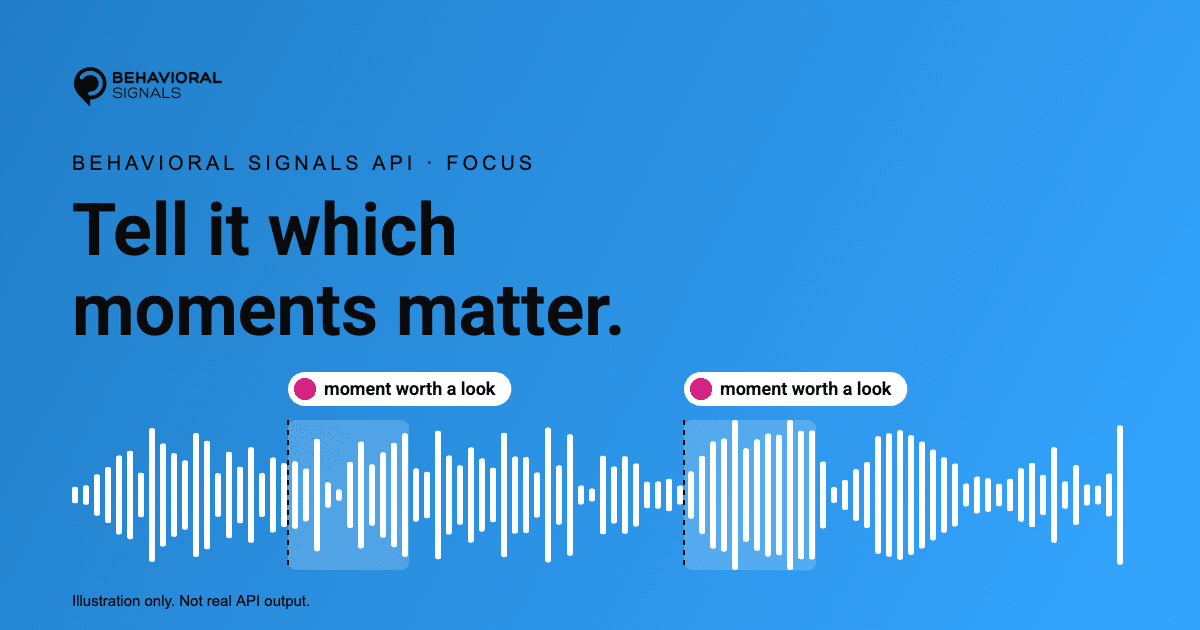
Emotion APIs return a lot of data. For every utterance, the Behavioral Signals API returns a probability for each class label of each behavioral task, and picking what to use is hard. Focus lets developers tell the API what matters to their application. They list the labels they want flagged and pick a sensitivity of low, default or high. Where a chosen label is likely but isn’t already the top result, the API adds a flag row with the same id, start time and end time as the utterance or segment it belongs to.
Also available: stress and confidence signals, built with Focus and added to your API output on request.
“Behavioral Signals has led the applied use of behavioral signals since Shri Narayanan’s foundational research, longer than anyone in this space. Focus builds on that: developers tell the API what matters for their application, and it flags the moment it happens.”
Jim Demetriades, CEO and Chairman of Behavioral Signals
What Focus does
- Tell it what matters. Choose labels such as angry, happy or negative tone, plus stress and confidence signals.
- Tune it to your context. High sensitivity flags more moments; low flags fewer.
- Nothing to migrate. Focus is a parameter on the results request developers already make, and a focus block in the first config message of a gRPC stream. Without a Focus request, results are exactly what they are today.
- Re-tune without re-uploading. In batch, Focus is worked out when results are read, so the same job can be read again with other labels or another sensitivity. Past jobs work too.
- Same labels in batch and streaming. One choice of what matters carries across both.
A flag marks a moment worth a look, based on how the speech sounds. It isn’t a statement about what the speaker feels.
Speaker diarization and ASR are included at no extra charge. The emotion and behavior models are paralinguistic: they read how something is said, not the words, so they aren’t tied to one language. Performance is strongest in the 11 languages they’re trained on.
Availability
Focus is available now in the Behavioral Signals API, in batch and streaming. New users start with 30 free minutes covering both batch and streaming, with no credit card needed. Documentation, labels and examples are in the Focus docs. See behavioralsignals.com/focus.
Teams moving off the Hume API can use Behavioral Signals as a drop-in replacement for the Hume API. See behavioralsignals.com/hume-ai-alternative.
About Behavioral Signals
Behavioral Signals builds AI that measures emotion and behavior in speech. Its Behavioral API returns emotion and behavioral signals per utterance, in batch and streaming, and its Deepfakes API detects synthetic voices. The same models run as a cloud API, in customer-hosted deployments and at the edge. The company spun out of USC’s Signal Analysis and Interpretation Laboratory (SAIL) in 2016, the lab behind pioneering work in machine detection of human emotion. The missing link: bringing EQ to AI IQ. behavioralsignals.com
Media contact: Popi Paraschaki, popi@behavioralsignals.com