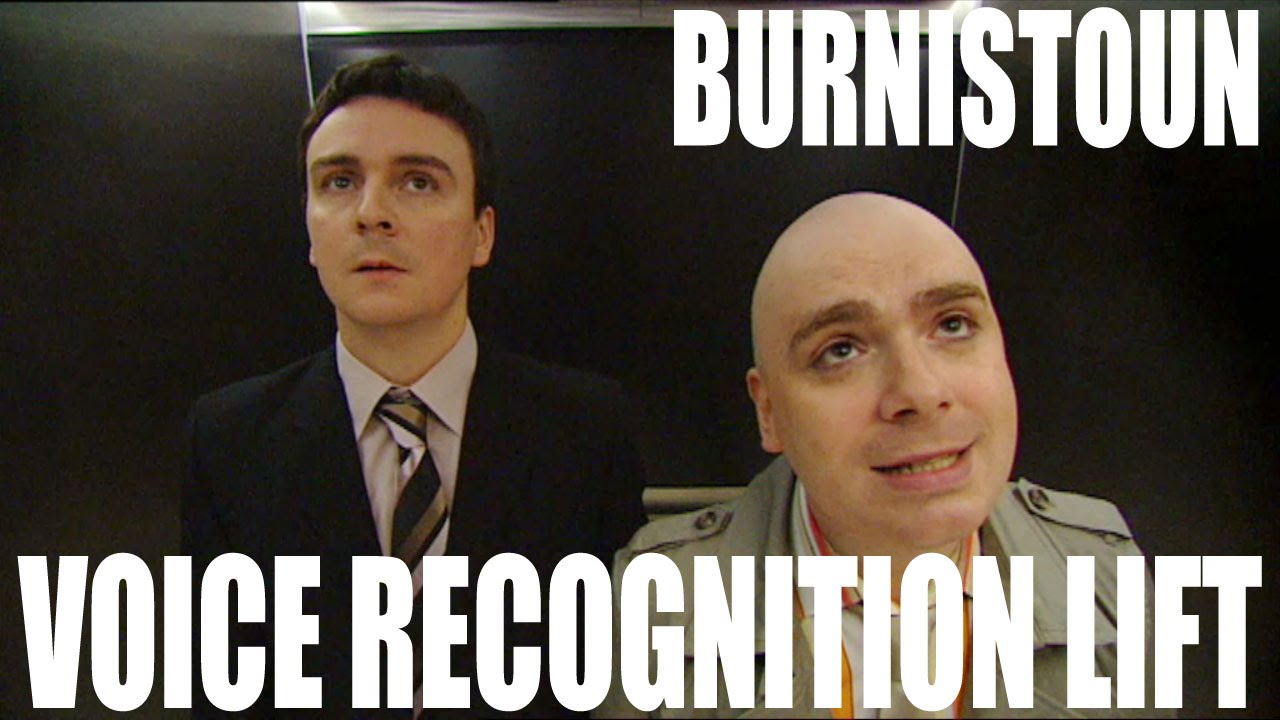
Image: Burnistoun, BBC Scotland
By Jim Demetriades, CEO, Behavioral Signals
Two men step into a lift in a fictional Scottish town, look for the buttons, and find none. The lift is voice-activated. They want the eleventh floor. They say “eleven.” The lift does not understand them. They try an American accent, then an English one, then they just keep saying “eleven,” on the theory that the machine might eventually learn Scottish. It never does. The sketch is from Burnistoun, the BBC Scotland series written by and starring Robert Florence and Iain Connell, and it still works because the problem is familiar: a system that listens only for the word, and has no ear for how people actually speak.
Credit: Burnistoun, BBC Scotland. This clip includes some strong language.
The lift only hears the word
The word is “eleven.” It is spoken clearly enough for anyone standing in the lift. The system still cannot match it to a floor. The joke is not that Scottish speech is unclear. The joke is that the machine was built to hear a narrow version of the word, and nothing around it.
That is a word-recognition problem, and it is a real one. Voice systems still stumble on accents, and this post is not a claim that we solve that problem. There is a second failure sitting next to it, and that is the one worth sitting with. While the two men argue with the lift, anyone listening can hear more than the word. You can hear the pace pick up. You can hear the strength in their voices. You can hear the joke curdle into frustration. None of that depends on whether the machine can spell “eleven.”
A voice system that only reads a transcript has a similar blind spot, even when the transcript is fine. How someone speaks — the accent, the rhythm, the pitch, the loudness, the speech rate — is also information.
What the voice carries besides the words
Speech researchers have a name for this: paralinguistics. It is a plain idea. The voice carries information that is not the words themselves. Accent is part of that. So are the patterns that show how someone is feeling, or how a conversation is going.
This is not a new observation, and it is not a product claim. It is a line of research that our cofounder, Shri Narayanan, has been part of for many years at USC’s Signal Analysis and Interpretation Laboratory, or SAIL. A few papers from that work are useful here. They are research papers, not tests of our product.
In 2013, Shri co-authored a review of paralinguistics in speech and language, tied to the INTERSPEECH paralinguistic challenges. It is an account of what can be read from the voice beyond the words.
Schuller, Steidl, Batliner, Burkhardt, Devillers, Müller, and Narayanan. “Paralinguistics in Speech and Language: State-of-the-Art and the Challenge.” Computer Speech and Language, 2013. https://doi.org/10.1016/j.csl.2012.02.005
Two years later he was a co-author, with ten other researchers, of GeMAPS, the Geneva Minimalistic Acoustic Parameter Set. GeMAPS proposes a small, shared standard set of voice measurements — pitch, loudness, voice quality, and related features — so that studies of emotion and of the clinical voice can be compared across teams.
Eyben et al. (Narayanan co-author). “The Geneva Minimalistic Acoustic Parameter Set (GeMAPS) for Voice Research and Affective Computing.” IEEE Transactions on Affective Computing, 2015. https://doi.org/10.1109/TAFFC.2015.2457417
A more concrete example came earlier. In 2007, Wang and Narayanan showed how to estimate how fast someone is speaking directly from the sound, with no transcript, by looking at syllable structure in the signal. Speech rate is a useful measure that lives outside the words.
Wang and Narayanan. “Robust Speech Rate Estimation for Spontaneous Speech.” IEEE Transactions on Audio, Speech, and Language Processing, 2007. https://doi.org/10.1109/TASL.2007.905178 · open copy
Once you treat speech as a signal, accent, prosody, and emotion-related measures sit on the same map. In our terms, those emotion-related measures are strength and positivity. They are different readings of how the voice is produced, not a separate trick.
We walk through this research in more depth on our research page and in our explainer on behavioral signal processing.
Hearing what the lift couldn’t
Here is where our models come in.
Our models are language-agnostic. They are built to work from the voice signal itself. They do not need to be trained on a given language first, and they do not need the accent to match a stored version of a word. They read how people speak: the tone, the pace, the strength and the positivity, and, through Focus, behavior cues such as stress and confidence. They can do that regardless of accent or language.
That is a different job from the lift’s. We are not claiming we would have gotten the two men to the eleventh floor. We are not in the business of recognizing the word “eleven” more reliably than a speech recognizer. The lift fails because it is listening for a word and cannot hear the accent. The meaning we are after does not depend on the accent. In that sense, we hear what the lift could not.
People bring accents, mixed speech, and more than one language into calls and into voice agents. A system that only listens for words will keep running into the same family of problems the lift runs into. A system that listens to how the voice is produced can still read the tone, the pace, and the cues of strength and positivity, even when the words themselves are hard to catch, or are spoken in a language the recognizer was not built for.
What this means for a voice agent
If a voice agent only reads the transcript, it misses the part of the signal that shows how the person is speaking. It may have the words and still miss a change in pace, a rise in strength, or a drop in positivity. Those are the cues that tell you whether a conversation is going well, or whether someone is under stress, or whether they sound confident.
That is the work our voice-agent emotion API is for: adding an ear for how people speak, next to whatever speech recognition you already use. The missing link: bringing EQ to AI IQ.
If you want to try it, the portal is the place to start. You can see how the API works, and you can see the pricing.